Treatment Powered by the Pioneers of TMS
At TMS Therapy Centers Colorado, we treat depression using the Magstim® Horizon 3.0 — an advanced, FDA-cleared TMS system built by the company that invented TMS technology more than 30 years ago.
- FDA-Cleared
- 30+ Years of Innovation
- 15,000+ Published Research Citations
- Non-Invasive
- No Anesthesia
What is TMS?
Transcranial Magnetic Stimulation, explained.
Transcranial Magnetic Stimulation (TMS) is an FDA-cleared, non-invasive outpatient treatment for depression that uses focused magnetic pulses — similar in strength to an MRI — to stimulate the areas of the brain that regulate mood.
In people living with depression, imaging studies show that key mood-regulating regions of the brain, particularly the left dorsolateral prefrontal cortex, can become underactive. Antidepressant medications attempt to address this chemically, traveling through the entire body before reaching the brain — which is why they often come with systemic side effects like weight gain, fatigue, and digestive issues.
TMS takes a fundamentally different approach. A treatment coil rests gently against your scalp and delivers brief, painless magnetic pulses directly to the targeted brain region. These pulses induce tiny electrical currents that "wake up" underactive nerve cells and, over a course of treatment, help restore healthy activity and connectivity in the brain's mood circuitry. Because nothing enters your bloodstream, there are no drug-related systemic side effects.
There is no surgery, no anesthesia, and no downtime. You remain fully awake during treatment, and you can drive yourself home, return to work, or go about your day immediately afterward.
The company that started it all
Magstim invented TMS — and has refined it for over three decades.
The Original TMS Pioneers
The very first trials of TMS in the 1980s were conducted using a Magstim stimulator. Every TMS system in the world traces its lineage back to this technology.
15,000+ Research Citations
Magstim devices have been cited in over 15,000 published scientific papers and are trusted by leading hospitals, universities, and research institutions worldwide.
FDA-Cleared Since 2008
TMS therapy was first cleared by the FDA in 2008 for adults with major depressive disorder who haven't responded adequately to antidepressant medication.
Recommended & Covered
TMS has been recommended by the American Psychiatric Association for major depressive disorder since 2010 and is covered by most major insurers, including Medicare.
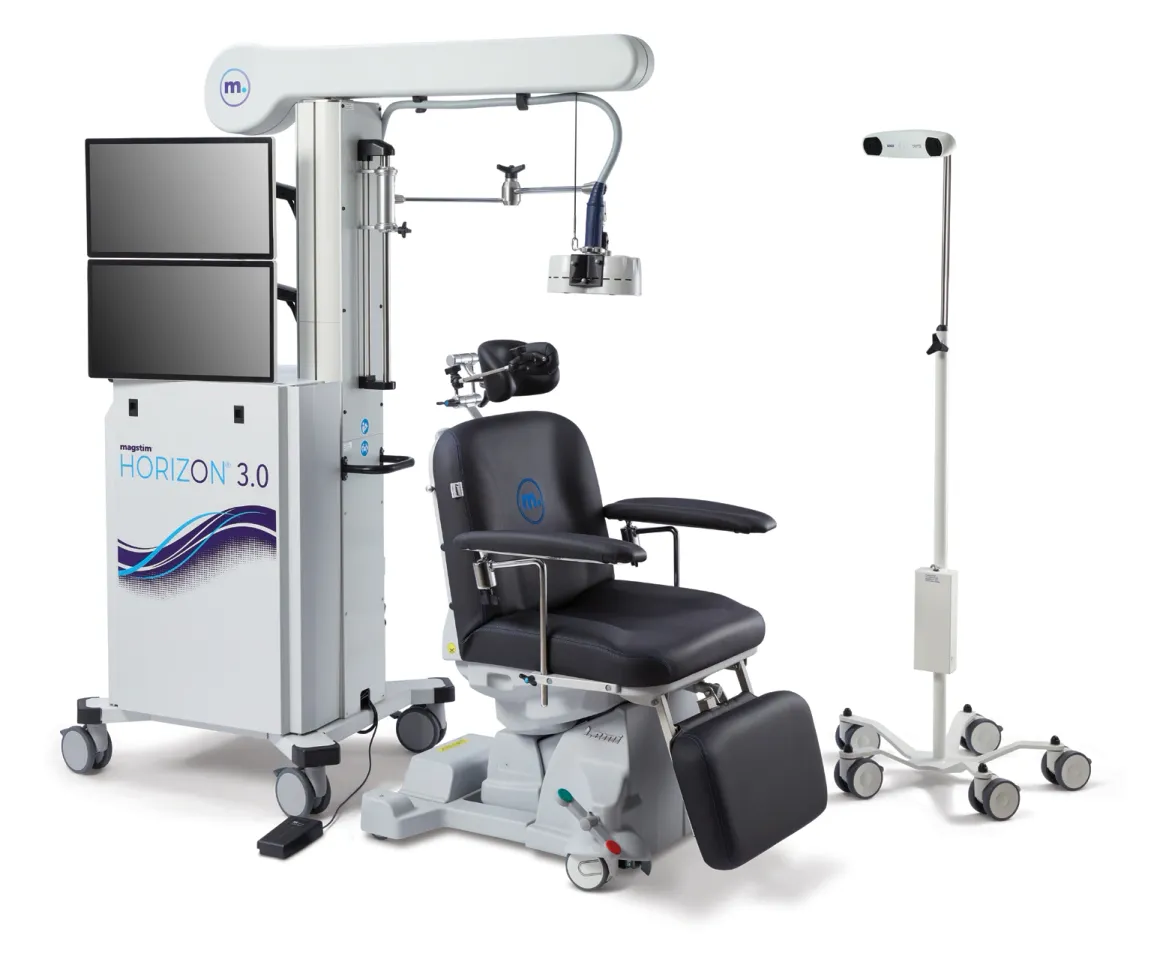
Meet the device
The Magstim Horizon 3.0.
The Horizon 3.0 is Magstim's most advanced clinical TMS platform — a new class of navigated TMS designed to deliver customized, repeatable, precisely targeted treatments.
- Guided precision targeting
Integrated navigation technology helps our clinicians position the treatment coil at the exact same spot, at the correct angle, every single session. The right dose, in the right location, every time.
- Consistent dosing with no pulse decay
The Horizon 3.0 delivers correct, consistent stimulation from the first pulse to the last, so every session delivers full therapeutic value.
- Four FDA-cleared indications, one coil
Magstim is the only TMS manufacturer FDA-cleared to treat major depressive disorder, OCD, anxious depression, and adolescent depression (ages 15–21) with a single treatment coil.
- Advanced air-cooled technology
Sessions run back-to-back without overheating delays, which means reliable scheduling and no waiting.
- Treatment analytics
Built-in data tracking lets our clinical team monitor your progress objectively across your entire treatment course.
- Comfort-first design
You relax in a comfortable reclining chair, awake and alert. Many patients read, listen to music, or simply rest during their session.
Who can TMS help?
Four FDA-cleared indications for Magstim TMS.
Major Depressive Disorder (MDD)
For adults who have tried antidepressant medication without adequate relief, or who can't tolerate medication side effects. This is the most established use of TMS, FDA-cleared since 2008.
Anxious Depression
Depression frequently travels with anxiety. Magstim TMS is FDA-cleared for anxious depression, addressing both the low mood and the anxiety symptoms that accompany it.
OCD (Obsessive-Compulsive Disorder)
TMS is FDA-cleared as a treatment option for OCD, offering hope when therapy and medication haven't been enough.
Adolescent Depression (Ages 15–21)
Magstim TMS is FDA-cleared for treating major depressive disorder in adolescent patients ages 15 to 21 — a meaningful option for young people and parents searching for alternatives to medication.
What to expect
Your sessions, step by step.
- 1
Free consultation & evaluation
We review your history, answer your questions, and verify your insurance benefits at no cost.
- 2
Mapping your treatment
At your first appointment, your clinician determines your personal "motor threshold" — the precise stimulation level for your brain — and maps the exact treatment location. Your protocol is customized to you.
- 3
Daily sessions, on your schedule
Treatment sessions are short — typically around 20 minutes — and are performed 5 days a week over approximately 6 weeks. You'll sit back in a comfortable chair while the coil delivers gentle pulses; most patients describe a light tapping sensation on the scalp.
- 4
Back to your day immediately
No sedation, no recovery time. Drive yourself, go to work, pick up the kids.
- 5
Tracking your progress
Using the Horizon 3.0's built-in analytics and regular symptom check-ins, we monitor your improvement throughout the course. Many patients notice changes within the first few weeks, with benefits that research suggests can last well beyond the end of treatment.
Safety & side effects
Well-studied. Well-tolerated.
TMS has been studied for more than three decades and is widely recognized as a safe, well-tolerated treatment. Because it is non-invasive and medication-free, it avoids the systemic side effects common with antidepressants — no weight gain, no sexual side effects, no sedation, no memory loss.
The most common side effects are mild and temporary: some patients experience scalp discomfort or tapping sensation at the treatment site, or a mild headache after early sessions. These typically fade as treatment continues. TMS is not the same as electroconvulsive therapy (ECT) — it requires no anesthesia, causes no memory impairment, and involves no recovery period.
TMS may not be appropriate for people with certain metal implants in or near the head. Your clinician will complete a full safety screening at your consultation.
See TMS in action
Video: TMS explained.
FAQ
Common questions about Magstim TMS.
Take the next step
Depression Treatment, Backed by 30 Years of Science.
Find out if Magstim TMS therapy is right for you — your consultation is free.
Request your free consultation
A care coordinator will call within one business day.